

 +86-13386111894
 Products & Solutions
 en
 English
 Русский
 España
 عرب .
If you need any help, please feel free to contact us
inquire
How Does a Pt100 Work? Platinum Resistance, Wiring, and Accuracy Explained
A technician clamps a three-wire Pt100 into an ice bath, connects it to a transmitter, and reads 100.00 ohms. In boiling water, the same sensor reads 138.51 ohms. That shift is the whole story: platinum resistance climbs in a stable, repeatable way as temperature increases. The Pt100 is named for its 100-ohm resistance at 0 °C, and its roughly 0.385-ohm-per-degree slope makes it a workhorse in food processing, HVAC, chemical reactors, and heat-treat furnaces. Knowing how a Pt100 works means knowing resistance, lead-wire compensation, and the small errors that decide whether your reading lands within a fraction of a degree or drifts several degrees off.
The Core Principle: Resistance Increases with Heat
Platinum has a positive temperature coefficient. As thermal energy increases, lattice vibrations scatter electrons more effectively, so resistance rises. For a Pt100, the nominal resistance at 0 °C is exactly 100 ohms. At 100 °C it is 138.51 ohms. At -200 °C it drops to 18.52 ohms. The relationship is close to linear over a wide range, but not perfectly straight, which is why industrial instruments use the Callendar-Van Dusen equation to convert resistance into temperature.
Above 0 °C, the equation is R = R0 (1 + A T + B T²), where R0 is 100 ohms, A is 3.9083 × 10⁻³, and B is -5.775 × 10⁻⁷. Below 0 °C, a fourth term with a C coefficient handles the curvature. IEC 60751 defines these values and the tolerance classes. The table below gives the nominal resistance at common temperatures.
| Temperature (°C) | Nominal Resistance (Ω) |
| -200 | 18.52 |
| -100 | 60.26 |
| 0 | 100 |
| 50 | 119.4 |
| 100 | 138.51 |
| 200 | 175.86 |
| 300 | 212.05 |
The slope is often quoted as 0.385 ohms per degree Celsius near 0 °C. That number is an average: the actual sensitivity changes slightly with temperature. A typical industrial transmitter measures the sensor resistance with a low excitation current, then linearizes the result in firmware or analog circuitry.
Inside the Sensing Element
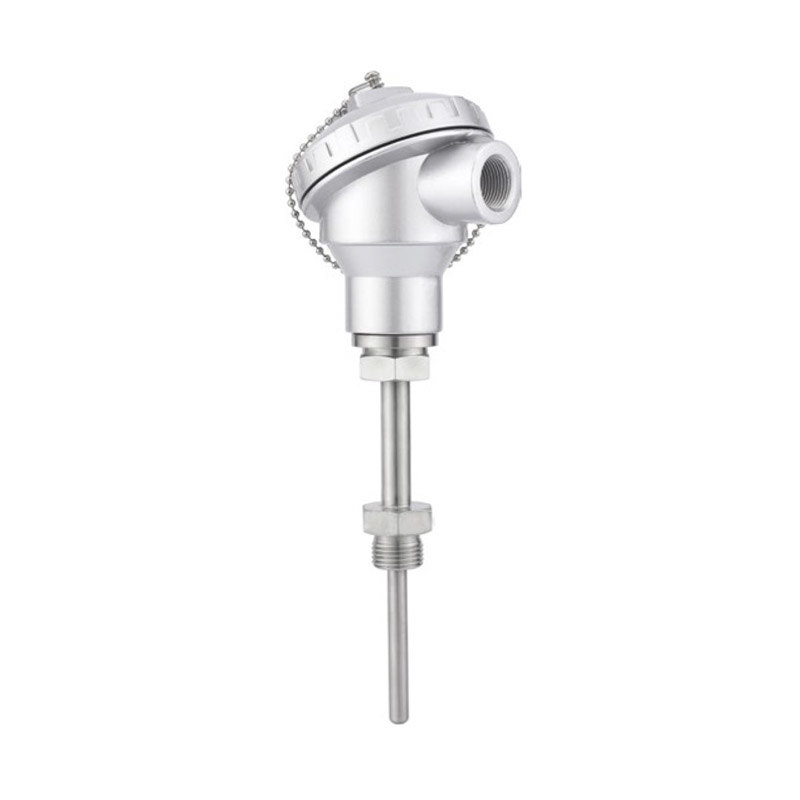
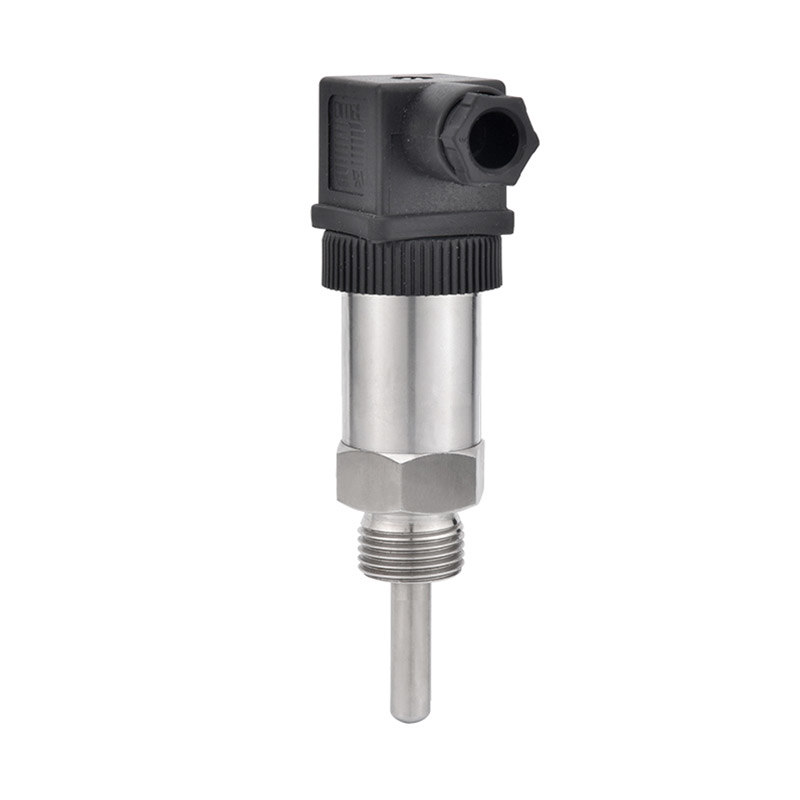
A Pt100 element is not just a lump of platinum. In a wire-wound design, a very fine platinum wire is wound around a ceramic mandrel or glass core. The assembly is coated, sintered, and fitted with lead wires. In a thin-film design, a meander pattern of platinum is deposited onto a ceramic substrate and laser-trimmed to the target resistance. Thin-film elements are smaller, faster, and less expensive; wire-wound elements often hold up better in high-vibration or high-temperature service.PT100 Temperature Sensor T300 with Stainless Steel ProbeA configurable PT100 sensor with 304 stainless steel housing, multiple probe and connection options, and suitability for water, HVAC, and automation systems.View Product →
The element is then packaged. A stainless steel sheath protects it from moisture, chemicals, and mechanical impact. The sheath may be 304 or 316 stainless steel, or a more exotic alloy for aggressive media. The lead wires run to a terminal head, a connector, or a cable. For sanitary processes, the sheath and connection are designed to be crevice-free and cleanable. For hazardous areas, the entire assembly may be explosion-proof.

Because the element is small, response time depends mostly on the sheath and the process. A bare element can react in a second or two. A heavy thermowell can stretch that to 30 seconds or more. That lag matters when you are controlling a fast exothermic reaction or a compressor discharge temperature.
Why Three Wires Exist
If you connect a Pt100 with two wires, the resistance of the lead wires adds to the element resistance. That error is not trivial. A 10-meter run of 0.5 mm² copper wire has roughly 0.35 ohms of round-trip resistance. At 0.385 ohms per degree, that is about 0.9 °C of error. In a 100-meter run, the error can exceed 9 °C. The three-wire connection solves most of this problem.
In a three-wire circuit, the instrument assumes the two lead wires have equal resistance. It measures the loop with one lead and the element in series, then measures the other lead, and subtracts. If the leads match in length, gauge, and temperature, the lead resistance cancels. The catch is that the assumption must hold. If one lead is longer, or if one terminal is corroded, the compensation is imperfect. A four-wire connection eliminates the problem entirely by using separate current-carrying and voltage-sensing leads.
| Wiring | Lead Resistance Error | Typical Use |
| 2-wire | Adds directly to element resistance | Short runs, low accuracy, Pt1000 |
| 3-wire | Cancelled when leads match | Most industrial transmitters |
| 4-wire | Eliminated | Laboratory, high-accuracy loops |
For a three-wire sensor, keep both leads the same length, the same gauge, and routed together. Use a shielded twisted pair or a three-conductor shielded cable. Ground the shield at one end only to avoid ground loops. If the cable run is long or noisy, a four-wire transmitter or a local transmitter with a digital output is often the better choice.
From Resistance to a Temperature Reading
The electronics that read a Pt100 usually do three things: excite the element with a constant current, measure the voltage across it, and convert that voltage to temperature. A common excitation current is 0.5 mA to 1 mA. Higher current improves signal-to-noise ratio but causes self-heating. Self-heating error depends on the sensor's dissipation constant and the medium. A small element in still air might rise 0.02 °C at 1 mA, while the same element in water might rise far less because heat is carried away quickly.
The raw resistance is not perfectly linear, so the instrument applies the Callendar-Van Dusen equation or a polynomial fit. A transmitter then outputs a standard signal: 4-20 mA, HART, Modbus, or a digital fieldbus value. Many industrial loops use a head-mounted transmitter that converts the Pt100 resistance to 4-20 mA right at the sensor, which reduces noise pickup and simplifies wiring.
Temperature transmitters in different industries often add features such as sensor matching, drift alerts, and redundant measurement. For a Pt100, sensor matching means the transmitter stores the exact Callendar-Van Dusen coefficients for that specific element, which can improve accuracy well beyond the standard tolerance class.
Accuracy Classes and Tolerances
Not all Pt100 sensors are created equal. IEC 60751 defines four tolerance classes. Class AA is the tightest, followed by A, B, and C. The tolerance is not a single number; it grows with temperature. At 0 °C, Class AA allows ±0.10 °C, Class A allows ±0.15 °C, Class B allows ±0.30 °C, and Class C allows ±0.60 °C. At higher temperatures, the allowable error widens according to the formulas in the table below.
| Class | Tolerance at 0 °C | Tolerance Formula |
| AA | ±0.10 °C | ±(0.10 + 0.0017|t|) |
| A | ±0.15 °C | ±(0.15 + 0.002|t|) |
| B | ±0.30 °C | ±(0.30 + 0.005|t|) |
| C | ±0.60 °C | ±(0.60 + 0.01|t|) |
Accuracy also depends on installation. A Class AA sensor in a poorly seated thermowell can perform worse than a Class B sensor with good thermal contact. Immersion depth should be at least ten times the sheath diameter, and more for high-accuracy work. Vibration, moisture, and thermal cycling can all cause drift over time, so periodic calibration is part of any serious temperature measurement plan.
Wiring, Shielding, and Installation Pitfalls
Most Pt100 problems are not in the element; they are in the wiring and installation. Use shielded cable and keep it away from motors, drives, and power lines. For a three-wire sensor, verify that both leads have the same resistance. A difference of 0.1 ohm between leads creates about 0.26 °C of error. Tighten terminals properly; a loose connection adds resistance and noise. Avoid running the sensor cable in the same conduit as high-voltage wiring.
Thermal issues are just as common. If the sheath is too short, heat conducts down the stem and the sensor reads the ambient temperature instead of the process. If the thermowell is too large, the sensor may not touch the bottom, and the air gap slows response. For industrial temperature measurement, the right combination of sheath material, process connection, and transmitter housing depends on the medium, pressure, and environment. A hygienic design is not optional in dairy or pharmaceutical service, and an explosion-proof housing is not optional in a solvent recovery unit.
Matching the Sensor to the Process
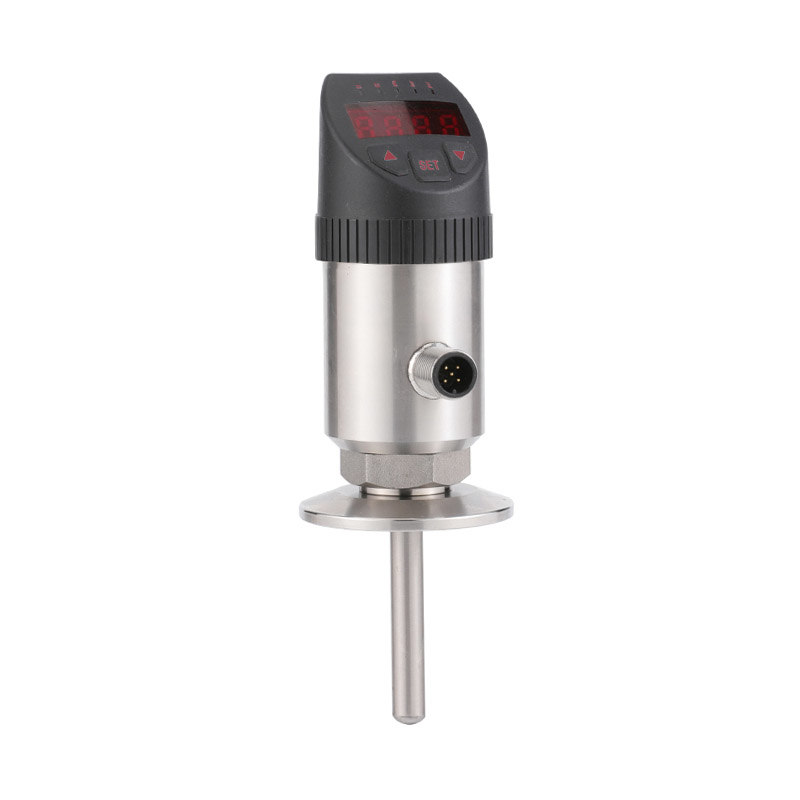
Choosing a Pt100 is a balancing act between accuracy, response time, durability, and cost. For a clean water line at moderate temperature, a standard 316 stainless steel probe with a Class A or B element is usually enough. For a fermenter or a clean-in-place line, a sanitary Pt100 with a crevice-free connection and a polished surface prevents contamination. For a reactor with aggressive chemicals, a PTFE-coated or alloy sheath may be necessary. For a high-vibration compressor, a wire-wound element and a robust sheath last longer than a thin-film element.Sanitary PT100 Temperature Sensor T310 with Stainless Steel HousingDesigned for sanitary applications, this PT100 sensor features a 304 stainless steel housing, configurable probe dimensions, and an optional flange connection.View Product →
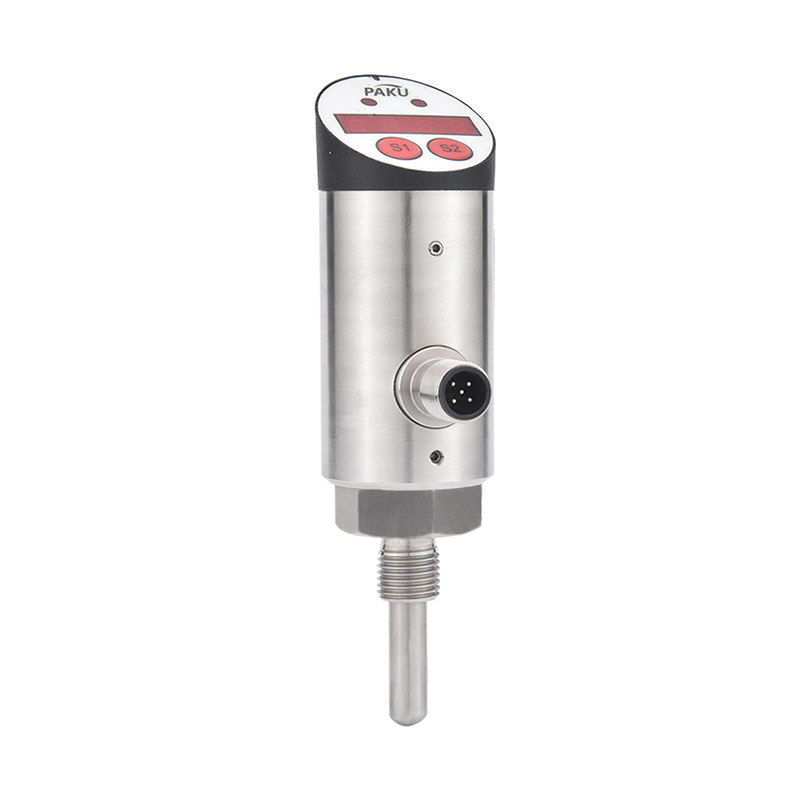
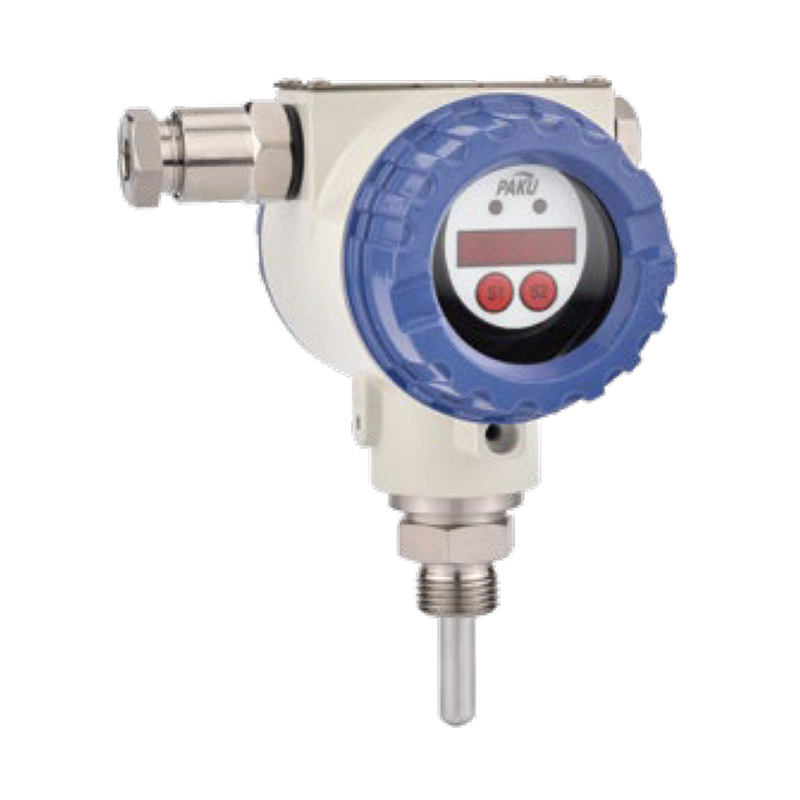
If the sensor is far from the control room, a head-mounted transmitter is often the best choice. It converts the resistance to 4-20 mA at the point of measurement, so the signal is less susceptible to noise and lead resistance. An integrated transmitter also simplifies calibration and can provide a local display. For hazardous areas, the transmitter and sensor must be rated for the zone. For high-temperature service, check the maximum temperature of the element, the sheath, and the transmitter separately; the weakest link sets the limit.Integrated Temperature Transmitter T450 with PT100 ProbeCombines a PT100 probe with an integrated transmitter, analog output options, and an optional display for field instruments and control panels.View Product →
Pt100 versus Pt1000 is another common question. A Pt1000 has 1000 ohms at 0 °C and a slope of about 3.85 ohms per degree. Its higher resistance makes lead resistance less important, so it works better in two-wire circuits. The trade-off is that the same excitation current produces more voltage and more self-heating, and the insulation resistance requirement is higher. For most industrial transmitters, either element works, but the transmitter must be configured for the correct type.
Testing and Troubleshooting a Pt100
A basic multimeter can catch most Pt100 faults. Disconnect the sensor from the transmitter and measure resistance across the element leads. At room temperature, you should see roughly 107.8 ohms at 20 °C. In an ice bath, a healthy Pt100 reads 100.00 ohms. In boiling water at sea level, it reads 138.51 ohms. If the reading is open, the element or a lead is broken. If it is near zero, the element is shorted. If it is plausible but wrong, the wiring configuration may be incorrect, or the sensor may be a Pt1000 or a different curve.
- Verify the sensor type and wiring diagram before applying power.
- Measure the element resistance with a calibrated multimeter and compare to the expected value.
- Check each lead for continuity and for resistance differences between leads in a three-wire sensor.
- Inspect the sheath, cable, and terminals for moisture, corrosion, or mechanical damage.
- Compare the sensor to a reference thermometer at a known temperature, such as an ice bath or a dry-block calibrator.
If the reading drifts, look for moisture ingress, a loose connection, or a change in the process. If the reading is noisy, check the shield, the grounding, and the routing. If the reading is slow, check the immersion depth and the thermal contact. Self-heating can also cause a small positive offset, especially in still air; reduce the excitation current if the transmitter allows it.
How does a Pt100 work? It works because platinum resistance rises with temperature in a way that is precise, repeatable, and well documented. The element gives you 100 ohms at 0 °C, about 0.385 ohms per degree, and a curve defined by IEC 60751. The three-wire connection handles lead resistance, the transmitter linearizes the signal, and the installation determines whether the accuracy class on the datasheet actually shows up in the process. Choose the element, sheath, and transmitter for the medium and the environment, keep the wiring clean, and verify the reading against a known temperature. Done right, a Pt100 can deliver reliable temperature measurement for years.
information
 [email protected]
 +86-13386111894 / +86-021-37566990
[email protected]
 B-4th Floor, Lane 1313, Nanting Road, Nanqiao Town, Fengxian District, Shanghai, China

Product Links