

 +86-13386111894
 Products & Solutions
  en
en English
 Русский
 España
 عرب .
عرب .
If you need any help, please feel free to contact us
inquire
Pressure Sensor: Types, How They Work & How to Choose
A pressure sensor is a device that measures the force exerted by a fluid — liquid or gas — on a surface and converts that measurement into an electrical signal. That signal is then used for monitoring, control, or safety functions across industries ranging from automotive and HVAC to oil and gas and medical equipment. Choosing the wrong sensor — even one rated for the right pressure range — can result in signal drift, premature failure, or hazardous measurement errors.
This guide focuses on practical selection and application: the types available, how each works, what specifications actually matter, and where each type performs best in real-world use.
How a Pressure Sensor Works
Nearly all pressure sensors work on the same fundamental principle: applied pressure deforms a sensing element, and that deformation is converted into an electrical output. The key difference between sensor types is what sensing element they use and how the deformation is measured.
The most common mechanism is a thin diaphragm — typically stainless steel, silicon, or ceramic — that flexes under pressure. The degree of flex is measured by one of several transduction methods:
- Piezoresistive: Strain gauges bonded to the diaphragm change electrical resistance as it bends. This is the most widely used technology, found in over 60% of industrial pressure sensors.
- Capacitive: Diaphragm movement changes the gap between two capacitor plates, altering capacitance. Highly sensitive, often used for low-pressure measurements below 10 inH₂O.
- Piezoelectric: Certain crystals (quartz, PZT) generate a charge when physically stressed. Ideal for dynamic pressure measurement but cannot measure static (steady-state) pressure.
- Resonant/vibrating element: Pressure changes the resonant frequency of a vibrating structure. Extremely accurate — used in precision and calibration instruments.
The output of the sensing element is conditioned by internal electronics and delivered as a standardized signal — most commonly 4–20 mA, 0–10 V, or digital protocols such as I²C, SPI, or HART.
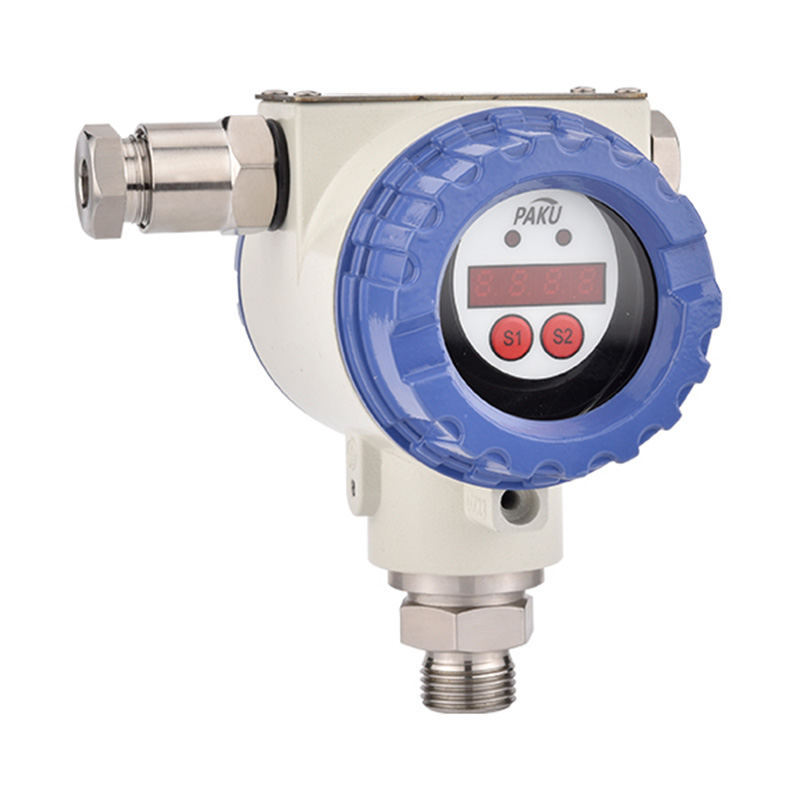
Pressure Measurement Types: Gauge, Absolute, and Differential
Before selecting a sensor, it is essential to understand what reference point your measurement needs. All pressure sensors fall into one of three measurement categories:
| Type | Reference Point | Reads Zero When | Typical Application |
|---|---|---|---|
| Gauge (PSIG) | Atmospheric pressure | At local atmospheric pressure | Tire pressure, hydraulic systems, water supply |
| Absolute (PSIA) | Perfect vacuum (0 pressure) | In a perfect vacuum | Altitude, barometric, vacuum processes |
| Differential (PSID) | Another pressure point | Both ports at equal pressure | Filter monitoring, flow measurement, level sensing |
A common and costly mistake is ordering a gauge sensor for an application requiring absolute measurement. For example, monitoring a vacuum drying process with a gauge sensor will produce readings that vary with atmospheric changes — rendering the data unreliable. Always define the measurement reference type before specifying a sensor.
Main Types of Pressure Sensors and Their Best Use Cases
Piezoresistive Pressure Sensors
The workhorse of industrial sensing. Piezoresistive sensors offer a good balance of accuracy (typically ±0.1% to ±0.5% full scale), wide pressure range coverage (from inches of water to 60,000 PSI), and competitive cost. They are temperature-sensitive, however — most require temperature compensation circuitry for accurate readings across a wide temperature range.
Capacitive Pressure Sensors
Capacitive sensors excel at measuring very low pressures — from 0.01 inH₂O to a few PSI — where piezoresistive designs lack resolution. They also have excellent long-term stability and low temperature sensitivity. Common applications include HVAC duct pressure, cleanroom monitoring, and medical respiratory equipment. Their drawback is susceptibility to EMI interference without proper shielding.
Piezoelectric Pressure Sensors
Piezoelectric sensors are designed exclusively for dynamic pressure events — rapidly changing pressures such as combustion chamber pressure, shock waves, or hydraulic hammer. They can respond in microseconds and withstand pressures exceeding 100,000 PSI in specialized versions. Because they produce a charge output (not a DC voltage), they cannot measure static pressure — the signal decays to zero even if pressure remains constant.
Ceramic (Thick-Film) Pressure Sensors
Ceramic sensors use an alumina diaphragm with thick-film resistors screen-printed directly on its surface. They are chemically inert, making them ideal for aggressive media including acids, alkalis, and seawater that would corrode stainless steel diaphragms. Food and beverage, chemical processing, and marine applications commonly use ceramic sensing elements.
MEMS Pressure Sensors
Micro-Electro-Mechanical Systems (MEMS) sensors are silicon-based, batch-manufactured devices that combine the sensing diaphragm and signal conditioning on a single chip. They dominate high-volume consumer and IoT applications due to their extremely small size (as small as 1mm²), low cost at scale, and low power consumption (some operate below 1 µA in sleep mode). Barometric sensors in smartphones, wearable health monitors, and drone altitude control all rely on MEMS pressure sensors.
Key Specifications to Evaluate When Selecting a Pressure Sensor
Datasheets for pressure sensors can list 20 or more specifications. In practice, the following are the ones that most directly determine whether a sensor will perform correctly in your application:
| Specification | What It Means | Practical Guidance |
|---|---|---|
| Pressure Range | Min and max measurable pressure | Select range so normal operating pressure sits at 50–70% of full scale |
| Accuracy / Total Error Band | Combined effect of offset, linearity, and hysteresis errors | Use Total Error Band, not just linearity, for real-world accuracy assessment |
| Overpressure Rating | Max pressure the sensor survives without damage | Should be at least 2× the maximum expected system pressure |
| Output Signal | Analog voltage, current loop, or digital protocol | 4–20 mA preferred for long cable runs (noise immune); digital for short distances |
| Temperature Range | Operating and compensated temperature limits | Compensated range is narrower — verify accuracy specs apply within your operating temps |
| Media Compatibility | Wetted materials vs. process fluid | Verify diaphragm material — 316L SS for most liquids, Hastelloy for aggressive chemicals |
| Long-Term Stability | Sensor drift over time at constant pressure | Expressed as % FS/year — critical for calibration intervals in safety systems |
Pressure Sensor Output Signals: Choosing the Right Interface
The output signal type determines how the sensor integrates with your control system, PLC, or data acquisition hardware. Each has specific advantages:
- 4–20 mA current loop: The industrial standard for process control. Current signals are immune to voltage drop over long cable runs (up to 1,000 feet or more) and are self-indicating for wire breaks (a reading below 4 mA signals a fault). Used in oil and gas, water treatment, and chemical plants.
- 0–5 V or 0–10 V analog: Simple and low-cost, but susceptible to noise and voltage drop over long cables. Best for short runs inside control panels or enclosures.
- Digital (I²C, SPI): Common in embedded systems, IoT sensors, and consumer electronics. Very short range — typically under 1 meter for SPI, a few meters for I²C without buffers.
- HART (Highway Addressable Remote Transducer): Overlays digital communication on a 4–20 mA loop. Allows remote configuration, diagnostics, and multi-variable reading without additional wiring. Widely used in smart instrumentation.
- CANbus / Modbus / IO-Link: Used in automotive, factory automation, and Industry 4.0 applications where networked sensor data and diagnostics are required.
Pressure Sensor Applications by Industry
Understanding how pressure sensors are used in specific industries helps narrow down the right technology and certification requirements:
| Industry | Typical Application | Preferred Technology | Key Requirement |
|---|---|---|---|
| Oil & Gas | Wellhead, pipeline, separator | Piezoresistive, 4–20 mA + HART | ATEX/IECEx explosion-proof rating |
| Medical | Ventilators, infusion pumps, blood pressure | MEMS, capacitive | Biocompatibility, ISO 13485 compliance |
| Automotive | MAP sensor, tire pressure (TPMS), fuel rail | MEMS, piezoresistive | AEC-Q100 automotive qualification |
| HVAC | Duct pressure, refrigerant, air handling | Capacitive, piezoresistive | Low pressure range, low power |
| Food & Beverage | CIP process, tank level, filling lines | Ceramic, flush diaphragm | 3-A or EHEDG hygienic certification |
| Water & Wastewater | Pump monitoring, network pressure, level | Piezoresistive, submersible | IP68 ingress protection, corrosion resistance |
Common Pressure Sensor Problems and How to Avoid Them
Even correctly specified sensors fail prematurely or produce unreliable data when installation and environmental factors are overlooked. The most common issues include:
Pressure Spikes and Water Hammer
Rapid valve closures or pump starts can generate pressure spikes 3–10× higher than normal operating pressure — far exceeding the sensor's overpressure rating. Install snubbers (pressure restrictors) or pulsation dampeners upstream of the sensor to protect against this. Snubbers with a 0.010–0.020 inch orifice effectively limit the rate of pressure rise reaching the diaphragm.
Temperature-Induced Errors
Process fluid temperatures significantly different from the ambient calibration temperature shift sensor zero and span. A sensor with a 0.02% FS/°C temperature coefficient measuring 100 PSI across a 50°C temperature swing will introduce a 1 PSI zero shift — potentially unacceptable in precision applications. Use remote seal diaphragms with capillary tubes to isolate sensors from high-temperature media.
Clogging and Diaphragm Fouling
Viscous, crystallizing, or slurry media can plug the pressure port or coat the diaphragm, causing reading errors or complete signal loss. Flush-diaphragm sensors (where the sensing element is mounted flush with the process connection, eliminating any cavity) solve this problem and are standard in food, pharmaceutical, and slurry applications.
Ground Loops and EMI Noise
Analog voltage output sensors are particularly vulnerable to electrical noise from motors, variable frequency drives, and power cables running parallel to signal wiring. Use shielded twisted-pair cable, ground the shield at one end only, and maintain at least 6 inches of separation between signal and power cables. Switching to a 4–20 mA current loop output eliminates most noise susceptibility.
Pressure Sensor Calibration: When and How Often
All pressure sensors drift over time. The rate depends on the technology, operating conditions, and whether the sensor has experienced overpressure or mechanical shock. General calibration interval guidelines:
- Safety and custody transfer applications: Calibrate every 3–6 months or per regulatory requirement (e.g., API, ISO 17025)
- General process control: Annually is typical for high-quality sensors with stability specs of ±0.1% FS/year or better
- After any overpressure event: Recalibrate immediately — overpressure permanently shifts the zero point in most piezoresistive sensors
- Consumer and IoT sensors: Typically factory-calibrated and not field-recalibrated; replace when drift exceeds application tolerance
For field calibration, use a deadweight tester or a precision reference gauge traceable to national standards (NIST in the US). A two-point calibration (zero and full scale) corrects both offset and span errors and is sufficient for most industrial sensors.
information
 [email protected]
 +86-13386111894 / +86-021-37566990
[email protected]
 B-4th Floor, Lane 1313, Nanting Road, Nanqiao Town, Fengxian District, Shanghai, China

Product Links