

 +86-13386111894
 Products & Solutions
  en
en English
 Русский
 España
 عرب .
عرب .
If you need any help, please feel free to contact us
inquire
Mechanical Pressure Switches: Working Principle & Selection Guide
Fundamental Operation and Core Components
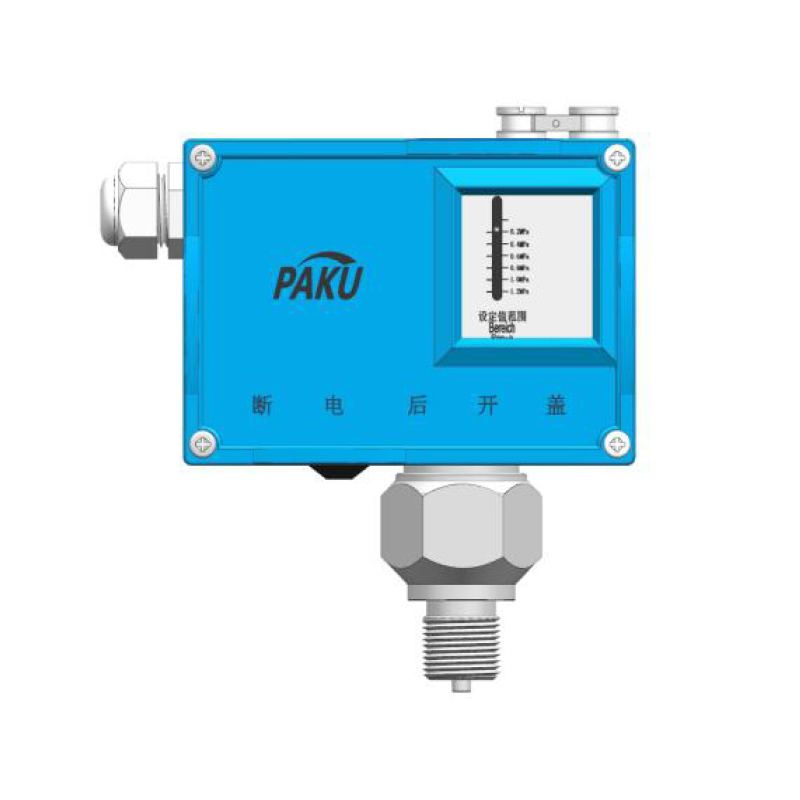
Mechanical pressure switches are robust electromechanical devices that convert fluid pressure into an electrical signal to control or protect industrial systems. Unlike electronic sensors that require external power and complex signal processing, these switches operate purely on physical force, making them highly reliable in harsh environments where electromagnetic interference or power fluctuations are concerns. Their simplicity ensures longevity, with many units lasting millions of cycles without failure.
The core mechanism involves a sensing element that deflects under pressure, actuating a snap-action switch. This direct mechanical linkage provides immediate response times, typically under 10 milliseconds. This rapid response is critical in safety applications such as hydraulic press protection or boiler over-pressure shutdowns, where even a slight delay can result in equipment damage or safety hazards.
Key Internal Mechanisms
- Sensing Element: Usually a diaphragm, piston, or Bourdon tube that moves in proportion to system pressure.
- Spring Assembly: Provides the counter-force to set the activation point; adjusting spring tension changes the switch point.
- Electrical Microswitch: A snap-action switch that opens or closes the circuit when the mechanical threshold is reached.
- Housing: Protects internal components from environmental factors like dust, moisture, and corrosion.
Diaphragm vs. Piston Switch Technologies
Choosing between diaphragm and piston designs is the most critical decision when selecting a mechanical pressure switch. Diaphragm switches are ideal for low-pressure applications and sensitive fluids, while piston switches excel in high-pressure hydraulic systems. Understanding the trade-offs between sensitivity, durability, and pressure range ensures optimal performance.
Diaphragm Switch Characteristics
Diaphragm switches use a flexible membrane, often made of rubber, Viton, or PTFE, to detect pressure changes. They offer high sensitivity and can operate at very low pressures, starting from just a few millibars. They are particularly suited for gas applications and low-viscosity liquids because the large surface area of the diaphragm responds quickly to subtle pressure variations. However, they are generally limited to pressures below 100 bar (1450 psi) and can be susceptible to tearing if subjected to pressure spikes.
Piston Switch Advantages
Piston switches utilize a precision-machined piston moving within a cylinder. This design is extremely robust and can handle pressures exceeding 600 bar (8700 psi), making them the standard for heavy-duty hydraulic machinery. The metal-to-metal sealing provides excellent durability against wear and tear. Piston switches are less sensitive to low pressures due to higher static friction, but their ruggedness makes them indispensable in industrial environments with high vibration and shock loads.
| Feature | Diaphragm Switch | Piston Switch |
|---|---|---|
| Pressure Range | Low to Medium (up to 100 bar) | Medium to High (up to 600+ bar) |
| Sensitivity | High | Low |
| Durability | Moderate | Very High |
| Best Application | HVAC, Pneumatics, Gas | Hydraulics, Oil & Gas |
Understanding Switch Point and Hysteresis
Accurate adjustment of the switch point and understanding hysteresis are essential for stable system control. The switch point is the pressure level at which the electrical contacts change state. Hysteresis, also known as deadband or differential, is the difference between the pressure at which the switch activates and the pressure at which it resets. Without sufficient hysteresis, the switch may "chatter" or cycle rapidly near the setpoint, leading to premature contact wear and motor damage.
Adjustment Procedures
- Connect a calibrated reference gauge to the system to monitor actual pressure.
- Loosen the lock nut on the adjustment screw to allow movement.
- Turn the adjustment screw clockwise to increase the switch point or counter-clockwise to decrease it.
- Slowly raise the system pressure until the switch actuates, noting the exact pressure reading.
- Lower the pressure to verify the reset point and calculate the hysteresis.
Managing Hysteresis
In many mechanical switches, hysteresis is fixed by design, typically ranging from 10% to 20% of the full-scale value. For example, a switch set to activate at 100 bar might reset at 85 bar, creating a 15-bar hysteresis. This wide band prevents rapid cycling in systems with pressure fluctuations, such as compressor tanks. However, in precise process control applications, this large differential may be unacceptable, requiring the selection of specialized switches with adjustable differentials or alternative electronic solutions.
Installation Best Practices and Common Failures
Proper installation is critical to ensuring the accuracy and longevity of mechanical pressure switches. Incorrect mounting, exposure to extreme temperatures, or ignoring fluid compatibility can lead to premature failure. Most failures are not due to manufacturing defects but rather application errors such as water hammer, vibration, or chemical corrosion.
Mitigating Water Hammer and Vibration
Water hammer, a pressure surge caused by sudden valve closure, can instantly damage sensing elements. To protect the switch, install a snubber or dampener device between the process line and the switch inlet. This restricts flow rate, smoothing out pressure spikes. Similarly, in high-vibration environments like pump skids, use switches with vibration-resistant designs or mount them remotely using capillary tubes to isolate the mechanism from mechanical shock. Failure to address vibration can cause contact chatter and false triggering within weeks.
Electrical Connection and Enclosure Ratings
Ensure the electrical rating of the microswitch matches the load. Inductive loads like motors and solenoids generate back-EMF that can arc and weld contacts. Using a snubber circuit or relay interface can extend contact life significantly. Additionally, select the appropriate IP (Ingress Protection) rating for the housing. For outdoor or washdown areas, an IP65 or IP67 rated enclosure is mandatory to prevent moisture ingress that could short-circuit the electrical terminals or corrode internal components.
Troubleshooting Checklist
- No Switching: Check for blocked pressure ports, broken sensing elements, or misadjusted springs.
- Leaking Fluid: Inspect O-rings and seals for chemical degradation or improper installation torque.
- Contact Welding: Verify load current does not exceed switch ratings; check for excessive voltage spikes.
- Inaccurate Setpoint: Calibrate against a reference gauge; check for temperature effects on spring tension.
information
 [email protected]
 +86-13386111894 / +86-021-37566990
[email protected]
 B-4th Floor, Lane 1313, Nanting Road, Nanqiao Town, Fengxian District, Shanghai, China

Product Links