

 +86-13386111894
 Products & Solutions
  en
en English
 Русский
 España
 عرب .
عرب .
If you need any help, please feel free to contact us
inquire
Mechanical Pressure Switches: Operation, Types & Selection Guide
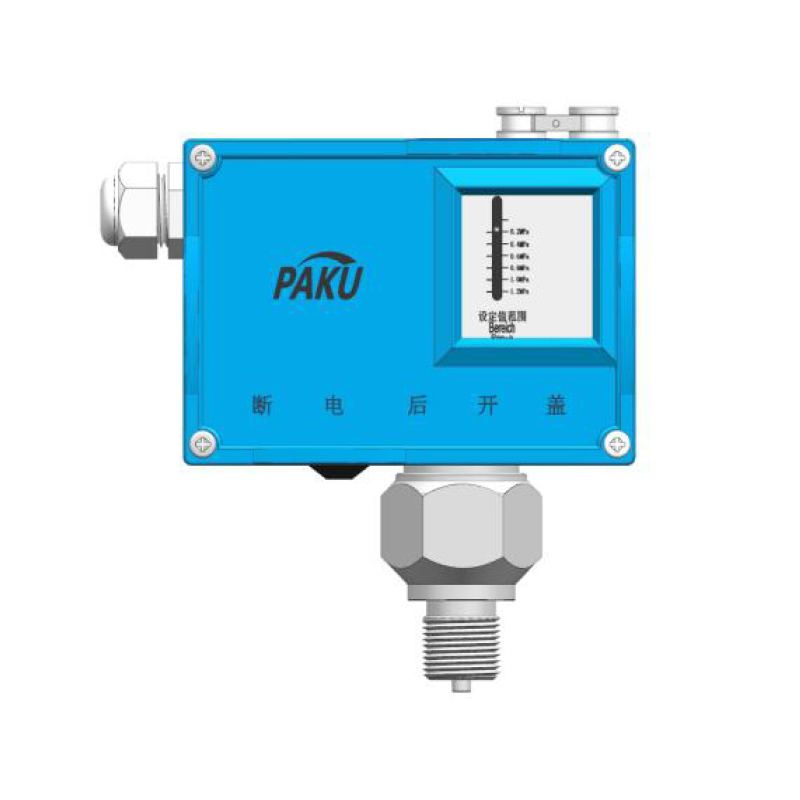
Mechanical pressure switches remain the backbone of reliable fluid power control in industrial, automotive, and HVAC applications. Unlike electronic sensors that require external power and signal processing, these devices operate purely on physical force, using a spring-loaded mechanism to open or close an electrical circuit when a specific pressure threshold is reached. Their robustness, simplicity, and ability to function in harsh environments with high electromagnetic interference make them indispensable for safety-critical systems where failure is not an option.
The core advantage of a mechanical pressure switch lies in its direct action. There is no need for analog-to-digital conversion or complex programming. When the process pressure exceeds the setpoint, the mechanical element deflects, overcoming the spring force and actuating the switch contacts. This immediacy provides a fast response time, often in milliseconds, ensuring rapid shutdown or activation of pumps, compressors, and alarms. For engineers, understanding the nuances of hysteresis, repeatability, and material compatibility is key to selecting the right unit for long-term reliability.
Operating Principles and Key Components
At its heart, a mechanical pressure switch consists of three primary components: a pressure-sensitive element, a pre-loaded spring, and an electrical microswitch. The interaction between these parts determines the switch's performance characteristics.
The Sensing Element
The sensing element converts fluid pressure into mechanical motion. Common types include diaphragms, bellows, and pistons. Diaphragms are ideal for low-pressure applications due to their large surface area and high sensitivity. Pistons, typically used in hydraulic systems, handle higher pressures and are more resistant to shock and vibration. The material of the sensing element, often stainless steel or brass, must be compatible with the process media to prevent corrosion and failure.
Spring Force and Setpoint Adjustment
A calibrated spring opposes the force generated by the sensing element. The tension of this spring determines the setpoint, or the pressure at which the switch activates. Users can adjust this tension via an external screw or knob. Precision springs ensure consistent performance over millions of cycles. However, spring fatigue over time can lead to setpoint drift, necessitating periodic recalibration in critical applications.
Understanding Hysteresis and Deadband
One of the most critical concepts in mechanical pressure switch operation is hysteresis, also known as deadband or differential. This is the difference between the pressure at which the switch trips (opens or closes) and the pressure at which it resets. Unlike electronic controllers that can have adjustable differentials, mechanical switches have a fixed hysteresis determined by the design of the mechanism.
| Switch Type | Pressure Range | Typical Hysteresis (%) | Application Example |
|---|---|---|---|
| Diaphragm | Low (0-10 bar) | 10-20% | HVAC Air Flow |
| Piston | High (10-400 bar) | 15-25% | Hydraulic Presses |
| Bellows | Medium (0-50 bar) | 5-15% | Refrigeration Systems |
Hysteresis prevents "chattering," or rapid cycling of the switch, which can occur if the process pressure fluctuates slightly around the setpoint. For example, if a pump cuts out at 100 psi and has a 20% hysteresis, it will not restart until the pressure drops to 80 psi. This ensures stable system operation and protects equipment from wear caused by frequent starting and stopping.
Selection Criteria for Industrial Applications
Choosing the right mechanical pressure switch requires balancing several technical parameters. Misapplication can lead to premature failure, inaccurate control, or safety hazards.
- Pressure Range: Select a switch where the operating pressure falls within the middle 50% of the sensor’s range. Operating near the maximum limit reduces lifespan and accuracy.
- Media Compatibility: Ensure the wetted parts (diaphragm, piston, seal) are compatible with the fluid. For corrosive chemicals, use stainless steel or Hastelloy. For oxygen service, ensure components are oil-free to prevent explosion.
- Electrical Rating: Match the switch contact rating (voltage and amperage) to the load. Inductive loads like motors require higher-rated contacts or snubber circuits to prevent arcing and contact welding.
- Environmental Conditions: Consider ambient temperature, vibration, and ingress protection (IP rating). High-vibration environments may require switches with dampened mechanisms to prevent false tripping.
Installation and Maintenance Best Practices
Proper installation is crucial for the accurate and safe operation of mechanical pressure switches. Incorrect mounting can introduce stress to the housing, leading to leaks or calibration shifts.
Mounting and Orientation
Always use a torque wrench when tightening the pressure port connection to avoid over-stressing the housing. For liquid applications, mount the switch with the pressure port facing up or sideways to prevent air pockets from forming in the sensing element. For gas applications, mount with the port facing down to allow condensation to drain away. Use a snubber or dampener if the system experiences pressure spikes or pulsations, such as those from reciprocating pumps.
Routine Inspection
Regularly inspect the switch for signs of leakage, corrosion, or physical damage. Test the switching function periodically by slowly increasing and decreasing the pressure to verify the trip and reset points. If the switch exhibits significant drift or fails to reset, it should be replaced rather than repaired, as internal spring fatigue or component wear is rarely reversible. Keep the electrical connections tight and free from moisture to prevent oxidation and resistance buildup.
information
 [email protected]
 +86-13386111894 / +86-021-37566990
[email protected]
 B-4th Floor, Lane 1313, Nanting Road, Nanqiao Town, Fengxian District, Shanghai, China

Product Links